
Two millennia ago, the vast Roman Empire ruled the Mediterranean and looked eastward with curiosity. Its ships plied the Red Sea and Indian Ocean, seeking spices, silks, and pearls from Asia. At roughly the same time, a network of kingdoms and trading ports flourished in the Malay world – from the rivers of the Mekong delta to islands of the Indonesian archipelago. These eastern lands were often beyond the direct sight of Roman eyes, but a web of trade linked them across the seas. By piecing together archaeological finds and ancient writings, we can tell the tale of how the Roman and Malay worlds touched each other, not by conquest, but through merchants, sailors, and intermediaries in India and China.
Here is an engaging, article-ready section describing the two ships in the generated image. You can insert this into your main 3000-word article under a section such as “A Meeting of Ships: Visualizing Two Maritime Worlds” or anywhere you see fit.
A Meeting of Ships: The Malay Jong and the Roman Galley
If one could freeze a moment in the vast, swirling expanse of Indian Ocean history, few scenes would be as evocative as the imagined meeting of a Malay trading vessel and a Roman war galley. The two ships—born of different technologies, climates, and maritime philosophies—represent more than wood and sail. They embody two distant civilizations whose goods once crossed oceans even if their sailors probably never saw each other face to face.
In the visual reconstruction of these vessels side by side, the contrast is striking. On one side floats the ancient Malay jong, a sturdy wooden ship with its unmistakably curved hull and a single, towering tan-brown sail made of woven plant fibers. The design speaks of a world defined by archipelago navigation: unpredictable monsoon winds, shallow coastal waters, and long voyages between islands. The Malay jong was wide-bodied, built from tropical hardwoods, and renowned for its strength. Its planks were stitched together with rattan or natural fiber lashings, a method perfected over centuries. Such ships could survive squalls that would rattle Mediterranean sailors and carry heavy cargoes of camphor, spices, resins, tortoiseshell, and forest products coveted far beyond Southeast Asia.
Opposite it stands the iconic Roman galley, lean and muscular, a vessel optimized for an entirely different kind of sea. With its smooth, elongated hull, crisp ivory-colored square sail, and banks of powerful oars, the galley was the machine of an empire built on the Mediterranean’s predictable winds and compact coastlines. Decorated with bronze shields and bearing a stern-standard emblazoned with imperial imagery, the galley embodied Roman discipline and engineering. Though capable of open-sea crossings, it was at its best hugging coasts, projecting military presence, and transporting diplomats, soldiers, and high-value goods.
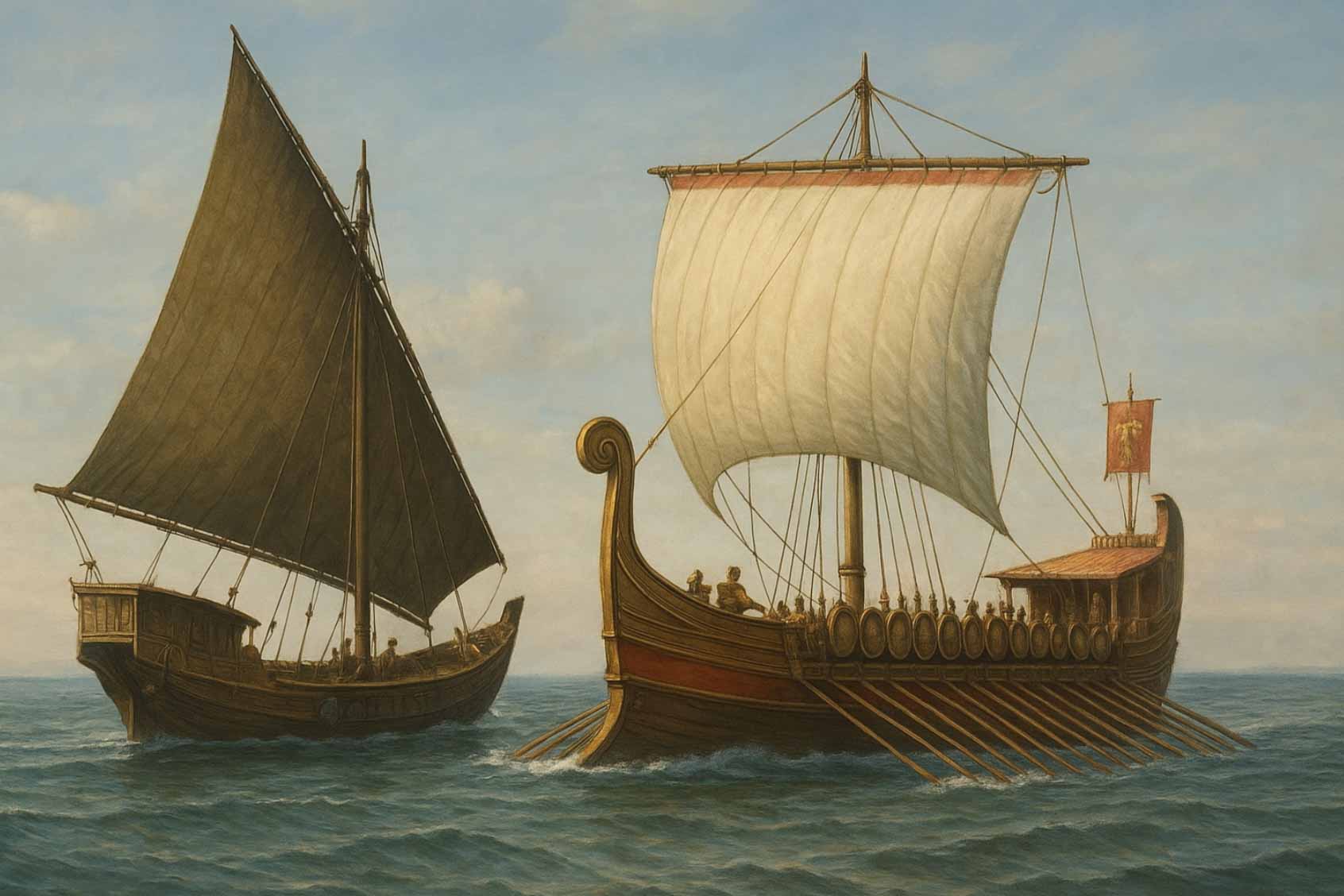
Malay Jong and Roman Galley
Placed together, the two ships reveal a world knitted together not by conquest but by commerce. The Malay vessel represents the maritime cultures that dominated Southeast Asian trade routes long before the rise of Srivijaya or Melaka; the Roman galley symbolizes the farthest reach of Mediterranean economic hunger.
Even without direct contact, both ships were part of the same global system. The cargo of the Malay jong—cloves from the Moluccas, benzoin from Sumatra, sandalwood from Timor—could eventually find its way to Roman markets through Indian intermediaries. Likewise, Roman glassware, beads, and bronze coins, traveling ship to ship, port to port, sometimes ending their journey on Malay shores, whisper stories of connections across worlds separated by half a globe.
Imagining these vessels side by side highlights the creative diversity of ancient naval technology. But more importantly, it symbolizes how trade linked peoples who never met, making the world of antiquity far more connected than one might assume. One ship speaks of empire; the other of islands and monsoons. Between them, across thousands of miles, flowed the luxury goods, ideas, and influences that stitched together the early foundations of global exchange.
Did the Romans Learn Shipbuilding from the Malays? Separating Fact from Speculation
The idea that the Roman Empire might have learned shipbuilding techniques from the Malay world has surfaced in recent years, sparking curiosity and debate. While this notion is intriguing, historians and archaeologists caution that it is highly speculative and unsupported by solid evidence. Let’s explore the topic in detail.
Roman Shipbuilding: A Mediterranean Legacy
Long before any possible interaction with Southeast Asia, the Romans had developed advanced shipbuilding capabilities of their own. Their naval knowledge drew heavily on Mediterranean traditions, particularly from the Phoenicians. The Phoenicians pioneered the use of the mortise-and-tenon joint, a method for joining planks underwater, which Romans later adopted and refined.
Archaeological studies and shipwreck evidence show that by the time of the First Punic War (264–241 BC), Romans were already constructing sophisticated vessels for both military and commercial purposes. Roman shipbuilding was, therefore, well-established long before any plausible contact with the Malay archipelago.
The 2025 Malay–Roman Shipbuilding Claim
In 2025, a lecturer at the International Islamic University Malaysia (IIUM), Solehah Yaacob, proposed that Romans might have borrowed some shipbuilding ideas from Malay sailors. She noted similarities between Roman and Malay ships, such as plank-based hull construction fastened with wooden pegs, and argued that the maritime expertise of the Malay world could have influenced Roman shipwrights.
The claim received attention in local media and sparked debate among academics. Articles appeared suggesting that the Romans could have learned certain techniques from early Malay maritime culture, a civilization that had been navigating Southeast Asian waters for centuries.
Why Mainstream Historians Remain Skeptical
Despite its appeal, the claim faces several critical challenges:
1. Timeline Mismatch: By the time Romans could plausibly have encountered Malay sailors, Roman shipbuilding was already highly advanced. The transfer of knowledge would have been unnecessary.
2. Lack of Archaeological Evidence: No Roman artifacts, shipwrecks, or ancient texts indicate contact with the Malay world. Similarly, there is no documentation of Southeast Asian influence on Mediterranean shipbuilding.
3. Independent Invention: Many historians argue that similarities in ship construction could be due to simultaneous invention, where different societies independently arrive at similar solutions to comparable problems, such as creating seaworthy plank-built vessels.
4. No Verified Trade or Cultural Contact: While Romans did have long-distance trade networks, there is no verified evidence they had meaningful contact with the Malay archipelago.
The Verdict: Fascinating but Unproven
Based on current evidence, the claim that Romans learned shipbuilding from the Malays is unsubstantiated. While it is an engaging hypothesis, mainstream scholarship treats it as speculative. Roman shipbuilding, with its roots in Mediterranean techniques, developed independently and was already sophisticated long before any possible interaction with Southeast Asia.
This does not diminish the incredible maritime expertise of the Malay world, which had a thriving shipbuilding tradition and dominated Southeast Asian waters for centuries. It simply shows that Roman naval technology evolved largely within its own cultural and geographic context.
The story of Romans potentially learning from the Malays is an example of how historical curiosity can spark provocative theories. While it captures the imagination, it also underscores the importance of evidence-based scholarship. Until concrete archaeological or textual proof emerges, the notion remains a fascinating “what if” rather than established fact.
Two Worlds Around the First Millennium AD
Rome at its height: In the first few centuries AD, Rome was one of history’s greatest powers. It controlled land from Britain to Persia and sea routes from Spain to Egypt. Roman merchants valued luxuries – Chinese silk, Indian spices and gems – and they were willing to pay in gold and silver. Pliny the Elder (Roman naturalist, 1st century AD) and others marveled that vast amounts of Roman gold flowed eastward to pay for Asian luxuries. Although Romans never sailed directly to Southeast Asia, they knew of far-off lands. Greek and Roman geographers even called the Malay Peninsula the “Golden Chersonese,” implying its legendary wealth (Ptolemy’s 2nd-century map names it Chersonesos Aurea).
The Malay region: In the same era, Southeast Asia was undergoing its own transformations. Along the river deltas and coasts grew Indianized kingdoms – early Funan (around the Mekong Delta), Langkasuka on the Malay Peninsula, and trading hubs in Sumatra and Borneo. These societies had sophisticated ports and crafts. They sent exotic goods (pearls, aromatic woods, ebony, and animals like elephants and rhinoceros) north to China and west to India. Chinese records from the late Han Dynasty (2nd-3rd centuries AD) note envoys from Funan bringing items like pearls, ivory and rhinoceros horn to China, a sign of far-reaching trade (even if those records do not explicitly mention Rome). In short, both regions were part of a world that traded across thousands of miles of ocean, even if they never met face-to-face.
Trade Across the Indian Ocean
The key to linking Rome and the Malay world was the Indian Ocean trade network. Monsoon winds made seasonal sea routes possible: ships from Roman Egypt sailed to the Arabian Peninsula and India when winds were favorable. Indian ports like Muziris (Kerala) and Barygaza (Gujarat) became major entrepôts. Roman merchants brought coins, wine in amphora jars, glassware, jewelry and wool, while loading up on pepper, gemstones, ivory, spices (like cinnamon and frankincense), cotton, and silk.
- Roman imports from Asia: Chinese silks and Indian spices were highly prized in Rome. Pliny noted that the luxury imports from India and beyond drained Rome’s treasury of gold each year. Roman shipwrecks have yielded luxury Indian textiles, and Rome’s markets surely stocked exotic Asian goods.
- Exports to the East: To get these goods, Romans mostly shipped gold, silver, and finished wares. Archaeologists emphasize that Roman coins were the currency of choice in overseas trade. A recent study notes that Roman merchants typically paid with precious metal coins, not base metals, for purchases in India and beyond. Roman wine or olive oil in amphorae also sailed east, as indicated by amphora fragments found in Indian Ocean sites (though fewer such finds in Southeast Asia are securely identified, they do appear in some sites in India and islands).
Importantly, Indian and Arabian intermediaries relayed goods between these worlds. Indian traders sailed east towards the Malay Peninsula and beyond. For example, Roman silver coins are common finds in South India and Sri Lanka – the Tamil kingdoms absorbed Roman bullion. Those same traders likely carried some of the goods onward to ports in Southeast Asia. Overland routes and coastal sea lanes linked Indian ports to places like Oc Eo (Funan, now southern Vietnam), Takua Pa (on the Thai Peninsula), and ancient Kedah (northwest Malay Peninsula).
Archaeological Echoes of Ancient Trade
Modern excavations have turned up real artifacts proving connections across Asia. At several Southeast Asian sites, scholars have found unmistakable evidence of far-traveled goods:
- Roman coins and imitations: In Vietnam’s Mekong Delta, the ancient port of Oc Eo (part of early Funan) has yielded coins from the Roman world. The UNESCO description of Oc Eo reports “copper Roman gold coins and medals” alongside Han-dynasty mirrors and Persian lamps. French archaeologist Louis Malleret (1950s) famously found two gold medallions at Oc Eo: one of Emperor Antoninus Pius and another of Marcus Aurelius (2nd century AD). In Thailand, too, one actual Roman coin has been found: an antoninianus (bronze coin) of the Gallic emperor Victorinus (269–271 AD) surfaced at U Thong (central Thailand) in modern times. The local Siamese Journal recounts that *“at present, the only Roman coin find in Thailand is the Victorinus coin found at U Thong”*. The fact that these coins traveled so far underscores ancient trade’s reach. (Many other coin-like finds at Thai sites turned out to be local gold imitations of Roman designs rather than genuine Roman mintings.)
- Roman-inspired jewelry: Southeast Asian craftsmen even copied Roman coin imagery. Excavations at Khlong Thom (southern Thailand) uncovered tiny gold pendants imitating Roman emperors’ portraits. One example is a gold pendant showing Emperor Commodus’s profile, virtually identical to a Roman coin design. Remarkably, this Oc Eo pendant shares technical details with imitations found at Khlong Thom, suggesting they were made by the same artisan. In other words, craftsmen in Thailand (around 200–300 AD) were deliberately fashioning jewelry after Roman coin types, likely learned via Indian contacts. This means the idea of a ruler’s portrait on a coin – a Roman innovation – had filtered eastwards by the early 3rd century AD.
- Glassware, beads and pottery: Roman-style glass objects and beads also turn up in Southeast Asia. For instance, archaeologists have unearthed Roman glassware fragments (possibly from wine flasks or tableware) at sites like Oc Eo, along with Mediterranean glass beads in beach-cast graves on the Thai-Malay coast. (A famous case is the “mosaic face” glass beads from Takua Pa, Thailand – likely made in Alexandria – which date to the 1st-2nd century AD.) Likewise, large storage jars (amphorae) from the Roman period, originally thought to appear at Indonesian and Malaysian sites, are often re-evaluated as later imitations; but some Roman-style jars do occur in small quantities in early Asian ports. Even intangible items like spices and gems were effectively ‘artifacts’ of the trade, carried by merchants rather than ships.
- Other foreign goods: The Oc Eo site contained artifacts from many lands. As UNESCO notes, Oc Eo has yielded *“Han bronze mirrors, Persian lamps, [and] glass materials, [and] precious metals imported from India and Mediterranean countries”*. This means that a visitor to Oc Eo would find objects made in Han China, in Sassanian Persia, in South Asia and even as far as the Roman Mediterranean – testament to an oceanic crossroads. Similarly, a Thai port like Tha Chana (near the Gulf of Thailand) has produced finds of Chinese, Indian and Mediterranean origin, confirming it was a stopping point on early trade routes.
Taken together, the archaeology tells a clear story: Southeast Asian ports were nodes in a vast network. Roman coins and glass reached Asia not by accident, but by design of commerce. Even if the quantities were small, each coin or amphora fragment is a “smoking gun” of contact.
What the Ancient Texts Say
Written records from the time are more oblique, but they fit the picture. Greek and Roman authors did not sail to Southeast Asia, but they heard tales of distant markets. In the Periplus of the Erythraean Sea (mid-1st century AD), an anonymous merchant’s guide describes sailing beyond India to the Malay Peninsula (called the Golden Chersonese), noting that goods continued to come and go along its coasts. Later Roman geographers like Ptolemy (2nd century) placed the Golden Chersonese on maps of the world. Pliny the Elder, writing around 77 AD, mentions a “Chryse” (Gold) island and promontory east of India – likely a vague nod to Sumatra or the Malay area. These classical writers did not have detailed reports, but their awareness shows they viewed Southeast Asia as the farthest frontier of the known trading world.
Far more pointed are Chinese records. Chinese dynastic histories (like the Hou Hanshu of the 5th century) describe contact with lands in the Bay of Bengal and beyond. They mention Funan (located in today’s Cambodia/Vietnam) and Kechcheari (probably parts of the Malay Peninsula and Sumatra). In one 3rd-century account, the king of Funan sends envoys to China, offering pearls, gold, and elephant tusks, and requesting silk in return. Although Roman traders are not mentioned by name, these Chinese texts demonstrate that Southeast Asian polities were actively trading for luxury goods – goods which, in some cases, originally came from the Roman sphere. A recent summary notes that by the second century AD, *“Chinese chronicles record the importance of Southeast Asian polities in trade networks stretching from the Near East to China”*, which implies that information about Rome and Persia was reaching the Far East through such channels.
In reverse, some Roman authors knew of China (calling it Seres or Sinae) but thought of it as an exotic end of the Silk Road rather than a maritime neighbor. The Roman historian Martial even speaks of seres (Silk People) in Asia trading with India. The Romans certainly desired Chinese silk – Roman laws even limited its import by heavy taxation. But they relied on Indian and Persian middlemen to bring it, and those middlemen in turn connected to Southeast Asia. Thus, in the surviving literature, the Malay world appears as part of the “far East” geography, painted by association rather than direct visit.
Indian Middlemen and Cultural Ripple Effects
Why no direct Roman ship to Thailand? Because it was more practical to stop in India. The sea voyage from the Roman Red Sea to southern India was already long; continuing to Southeast Asia meant another open-ocean crossing. Instead, Indian Ocean traders of Tamil Nadu, Ceylon (Sri Lanka) and southern Arabia acted as middlemen. They welcomed Roman cargo at ports such as Muziris and Arikamedu (in Tamil lands), and then bid sail eastward with their own goods.
These Indian and Southeast Asian merchants digested Roman culture and goods and re-exported them. For example, many Roman gold coins have been found in South Asia (often recycled by local kings). Southeast Asia saw some of this influence: the Khlong Thom gold pendants mentioned above reflect the concept of Roman-style coins (portraiture, imperial titles) adopted in Thai crafts. Scholars believe that Indianized Southeast Asia copied the idea of standardized coinage (a concept from the Graeco-Roman world) around this time, likely inspired by Indo-Greek and Roman examples in nearby India.
Similarly, Roman glass-making techniques are thought to have influenced glass bead production in Asia. The famous mosaic-face beads of Takua Pa (Thailand) were made in a style common in Roman Egypt. Indian artisans in Southeast Asia may have learned or traded for these beads and designs. Although Southeast Asian societies did not become “Romanized” in language or government, they absorbed small cultural elements via India: decorative motifs, gemstone use, and coin symbols. Even religion traveled this route: Greek influence on Buddhist art (the Gandharan style) went from Hellenistic kingdoms into India and thence into Southeast Asian sculpture. So indirectly, Greco-Roman aesthetics crept into the region’s art through Indian intermediaries.
Economically, Roman silver also affected India’s economy: Roman denarii often were melted down and minted into local coins. In turn, Indian coins and bullion found their way east. Archaeologists note that in Oc Eo’s excavations, not only Roman items but “precious metals imported from India and Mediterranean countries” were present. This suggests that Funan (Oc Eo) saw both Indian goods and leftover Mediterranean coins. Inscriptions and relics from early Southeast Asian sites often mention Indian dynasties (e.g. mention of Gupta or Pallava gifts) rather than Rome, but the goods those dynasties carried on included Roman artifacts.
In short, India was the bridge: Roman gold and goods landed in Indian ports, and Indian traders ferried them further east. Indian sailors also brought Southeast Asian spices, woods, and exotic products westward to the Roman market. The entire trade remained a relay race of merchants. As one study puts it, “Roman coins and their imitations demonstrate [the] value of these rare foreign objects” in early Southeast Asian trade.
After Rome: Echoes and Transitions
By the late 3rd–5th centuries AD, the Roman Empire in the West was declining, and its trade focus shifted. In the East, new powers like the Gupta Empire in India and later the Sassanian Empire in Persia took over roles in trade. Nevertheless, the maritime routes paved during Roman times endured. One telling shift was that, by the 7th century AD, the center of trade moved westward to Sumatra: the Srivijaya empire (based in Palembang, Sumatra) came to dominate the Straits of Malacca. UNESCO notes that *“from the 7th century, [trade] shifted from Oc Eo to Palembang – the capital of Srivijaya”*. In other words, the once-busy Funan ports in Vietnam and Cambodia declined, and the Malay trade network realigned around Sumatra and the Malay Peninsula under Srivijaya. But the routes themselves – connecting India, Southeast Asia and China – were essentially the same.
The “Roman legacy” in later Southeast Asian history is subtle. Empires like Khmer and later the Muslim sultanates of the Malay Archipelago did not directly inherit Roman culture or religion. However, the ancient trade connections persisted in memory and material. Even in medieval times, Arab, Persian, Indian and Chinese traders continued those old links, now conveying Islam and new dynasties instead of pagan Roman goods. Remarkably, Roman coins kept turning up in later periods as curiosities: besides the Victorinus denarius in Thailand, one Roman coin was famously found in 1930 at Kedah (Bujang Valley, Malaysia) – though some of those old claims remain debated.
In Europe, Renaissance cartographers revived Ptolemy’s Geography, and sailors remembered legends of distant lands (the name Chersonese Aurea lived on in maps). But it was not until the Age of Exploration (16th century) that Europeans again fully penetrated Southeast Asia – this time seeking the spices that Romans once dreamed of. By then, Indonesia and the Malay Peninsula had their own powerful states (like the Malacca Sultanate) and were part of an Islamic trading world.
Today, the physical echoes of Rome in Southeast Asia – coins, beads, amphora fragments – are scattered museum pieces. Each one tells a story. For example, a small Roman silver coin dug up near an ancient temple sends imaginations flying: how did it get there? The answer lies in a millennia-old network of merchants and monsoons. Our modern scholars piece together that story from layers of dirt and faded books. While Rome and the Malay kingdoms never met armies or built roads to each other, they were part of a shared economic world. The Roman Empire and the Malay world converged not in conquest but in commerce.
References
Historians and archaeologists have documented these links. Excavations at Vietnam’s Oc Eo site found Roman coins and glassware. Reports from Thailand describe Roman-style gold pendants and the lone Roman coin of Emperor Victorinus at U Thong. Chinese chronicles of the Han period speak of Southeast Asian kingdoms trading with the world beyond. Modern studies (e.g. analyses of ancient coins and beads) confirm a network of trade from the Near East through India to Southeast Asia. Taken together, these findings tell the complete story of a distant but real encounter between Rome and the Malay world.